
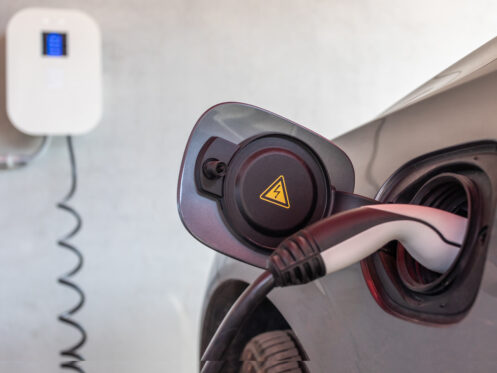
Purchasing an electric vehicle can be a great investment. EVs are better for the environment than combustion vehicles. An EV can also save you a significant amount of money over time by not having to continually pay to refuel your vehicle. The only thing you will need to worry about is being able to charge the battery to ensure you always have sufficient range to get wherever you need to go.
One of the first things most EV owners realize is that the Level 1 charging cord, which comes with the vehicle, simply isn’t sufficient due to how slowly it charges the battery. Needing to rely on faster public charging stations is also inconvenient and can be costly. The solution to avoiding all these issues is to simply install a Level 2 home-charging station. A Level 2 station allows you to get a full charge overnight, but it can also add quite a bit to your home’s electrical load and may require an upgraded electrical panel to handle the additional load.
Electrical Load Requirements for an EV Charging Station
Level 2 EV charging stations are 240 volts, and the National Electrical Code (NEC) requires them to have their own dedicated circuit. While all Level 2 stations are 240 volts, the amount of power a station draws depends on its amperage. Charging stations range from 15 amps all the way up to 80 amps. The higher the amperage is, the faster the station will charge your vehicle’s battery.
Interestingly, a 15-amp charging station will still charge your vehicle faster than using a Level 1 charging cord, as Level 1 chargers are only 120 volts. However, a 15-amp station still won’t be sufficient in most cases unless you only have a fairly short daily commute. The only real upside of installing a 15-amp station is that your electrical system will most likely be able to support the load without needing to upgrade to a higher-amperage electrical panel.
Even though there are 80-amp stations available, most EV batteries can only charge at up to 48 amps. There are some more-efficient EVs that can charge at a rate of up to 80 amps, but they are somewhat rare and tend to be far more expensive. Nonetheless, installing an 80-amp station can be a way to future-proof your house just in case you upgrade to a new EV. With an 80-amp station, you can also charge two vehicles at the same time with no issue.
One important thing to understand is that an 80-amp station doesn’t have to operate at 80 amps. Most EVs allow you to adjust the charging speed, and many charging stations also let you choose the amperage at which you want to charge. In general, you should always charge at as low of a speed/amperage as possible to help protect the life of the battery.
When considering electrical load requirements, it’s essential that you never exceed 80% of a circuit’s total capacity or amperage rating. Otherwise, fluctuations in power can result in the circuit frequently getting overloaded and causing the breaker to trip.
To avoid overloads, a 15-amp charging station needs to be on a circuit with a 20-amp breaker. A 48-amp station needs a 60-amp breaker, and an 80-amp station requires a 100-amp breaker. Even though the station usually won’t draw that many amps, you still need to factor in the amperage of the breaker when determining if your electrical system can handle the charging station’s load.
The Importance of Avoiding Electrical Overloads
Overloading your home’s electrical system can have numerous consequences, some of which can be extremely serious. The biggest concern is that an overload can lead to an electrical fire. Anytime the current electrical load exceeds the amperage of your electrical panel, it can result in the wiring within the panel getting extremely hot and potentially starting to burn or melt.
Overloads can also do considerable damage to appliances and electronic devices. If your electrical service panel doesn’t have sufficient amperage, high-amperage appliances, like an EV charging station or AC unit, can use most of the available power when they’re on. When the appliance turns on and shuts off, it can lead to power surges or fluctuations in voltage in all of the other circuits. While this type of power surge is usually minor, repeated surges still damage sensitive electronic components and can lead to appliances and electronic devices not lasting as long or just suddenly failing.
Do You Need an Electrical Service Upgrade Before Installing an EV Charger?
The National Electrical Code (NEC) requires that all new homes have at least 100-amp electrical service, although many newer houses have a 150-amp or 200-amp service panel. Some older homes built before the NEC requirements were updated in 1959 only have a 60-amp service panel, which almost certainly isn’t sufficient to handle the load of an EV charging station. The only exception is for a small house that doesn’t have any other 240-volt appliances, such as an electric clothes dryer or air conditioner. Even a 100-amp service panel isn’t always sufficient to handle the load of a charging station, unless you only want to install a low-amperage station or are only ever going to charge your vehicle overnight when everyone is asleep.
The best way to know if you need to upgrade your electrical service before installing an EV charging station is to have an electrician perform a load calculation. This calculation essentially just involves adding up the wattage of all the appliances, electronic devices and lights in the house. It’s slightly more complicated than that, though. The formula electricians use doesn’t factor in 100% of all the loads, as there should never be a time when everything in the house is on at the same time. If you generally only plan on using the charging station overnight when your total electrical load is much lower, the electrician will take this into account as well. That said, you should still plan for situations where you need to charge your vehicle at other times when the load is higher.
The load calculation allows an electrician to accurately determine if your existing electrical service is sufficient and how powerful of a charging station you can install without risking an overload. Electricians will usually recommend upgrading to a 200-amp panel before installing the charging station. Part of the reason is that it allows you to prepare for the future in case you want to put an addition on your house, install additional circuits, etc.
Christian Brothers Air Conditioning Plumbing Electrical is proud to be the most trusted name in Glendale for EV charging-station installation. We’ve been serving homeowners since 1976 and can help make sure you get the right charging station for your home. We’ll also evaluate your electrical system and determine if you need an electrical panel upgrade or if your existing service is sufficient. Safety and customer satisfaction are at the forefront of everything we do, and you can count on our experts to ensure that the installation process goes smoothly from start to finish. If you want to install an EV charging station for your home, give us a call to set up an electrical-system evaluation and consultation.