
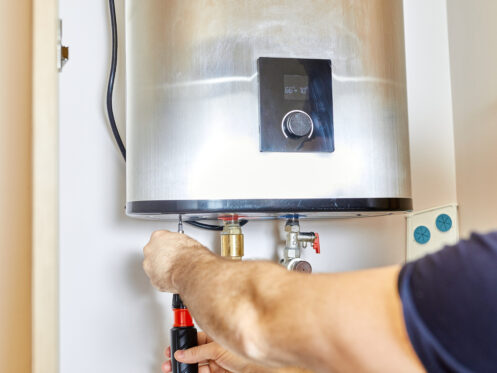
Living in a small home often means finding creative ways to maximize storage and accommodate essential appliances. Traditional water heaters with bulky tanks can take up valuable space, making it challenging to maintain an efficient layout. This conundrum is why many homeowners in smaller spaces turn to tankless water heaters for a solution. This article will explore how tankless water heaters stack up against traditional systems and why they can be an ideal choice for small homes.
Saving Space
Traditional water heaters typically require a 40-gallon or larger tank to meet the hot water needs of a small home. While this may not seem excessively large, these tanks can occupy a significant amount of space that could be used more efficiently. In contrast, tankless water heaters are much smaller, often no larger than a suitcase, with dimensions around 2 feet tall, 1.5 feet wide, and only a few inches deep. This compact size allows them to be installed on a wall in your bathroom or tucked into a storage closet, freeing up valuable floor space.
If you want to install the water heater in your bathroom but are concerned about aesthetics, you can build a cabinet around the unit so it’s hidden from view. However, you’d need to make sure that the cabinet is large enough to meet the unit’s clearance requirements for safety reasons. For a gas tankless unit, you’d also need to make sure that the cabinet provides sufficient ventilation.
If your home has a single bathroom, you might save even more space by installing multiple point-of-use tankless units instead of one larger whole-home unit. For instance, you could place one compact unit beneath your kitchen sink to supply hot water to your sink and dishwasher while another unit provides hot water for the bathroom and washing machine. In such cases, electric tankless units are often a better choice than gas models. Electric units do not require external venting, which makes them easier to install in confined spaces like cabinets or closets.
Unlimited Hot Water Supply
Another issue with having a traditional water heater in a small house is that you may need more space to install a large enough unit to meet your needs. For instance, if three people live in the house, a 40-gallon tank will not have enough storage to allow all three people to shower back to back. That means you’ll frequently have times when you run out of hot water and then have to wait up to an hour or potentially even longer before you can start using hot water again. Tankless water heaters provide hot water on demand, eliminating this hassle.
A Note on Lag Time
One of the few drawbacks of a whole-home tankless water heater is that it often has a longer lag time compared to a traditional water heater. Lag time refers to the delay between turning on a fixture, like a shower, and when hot water begins to flow at the desired warmth. Any water heater will have some lag time, as water must travel from the appliance to the fixture, and it can initially lose heat as it flows through cold pipes. This effect is typically more noticeable during winter months when pipes are colder.
The longer lag time with tankless water heaters happens due to how they heat water. When you turn on a fixture, the tankless unit activates and takes a moment to bring the water up to temperature before it flows through the pipes. In contrast, traditional water heaters store a supply of preheated water from a tank, allowing hot water to flow immediately when needed.
However, in smaller homes, the difference in lag time between tankless and traditional water heaters is often negligible. Shorter distances between the water heater and your fixtures mean hot water arrives more quickly, even with a tankless unit. Point-of-use tankless water heaters are a great solution for those who want to reduce lag time further. Professionals install these smaller units near individual fixtures so the hot water only needs to travel a short distance, typically reaching the fixture within seconds. Additionally, insulating your pipes can help minimize heat loss during water travel, reducing the overall lag time.
Lower Water Heating Costs
Tankless water heaters waste far less energy and are thus much more energy efficient than traditional units. The biggest issue in terms of the efficiency of a tanked water heater is that it takes a lot of energy to keep the water consistently hot. That’s because some heat is continually lost to the surrounding area, resulting in the unit needing to reheat the water frequently. This issue is known as standby heat loss and is the reason why a traditional water heater typically runs for a few hours a day, even if no one is home using hot water. In a small home where your daily hot water usage is low, a tankless water heater will use around 25% to 35% less energy on average than a traditional unit would.
Long Life Expectancy
When deciding between a tankless and a tanked water heater, longevity is an essential factor to consider. Tankless water heaters typically last much longer than traditional models, with a life expectancy of 20-25 years compared to 10-15 years for tanked units. This extended lifespan can make tankless units a more cost-effective investment over time despite their higher initial price.
The main reason tankless water heaters last longer lies in their design and operation. Over time, water storage and constant heating can lead to mineral buildup inside the tank, causing corrosion and eventual failure. The tank’s internal lining and components also experience wear from repeated exposure to water, especially if yours contains a lot of minerals.
Tankless water heaters, by contrast, eliminate tank corrosion concerns. Additionally, they have fewer parts exposed to water, so there’s less wear and tear overall. A tankless water heater can maintain peak efficiency for decades with proper care.
Another factor contributing to the longevity of tankless water heaters is their modular design. Many units allow for the replacement of individual components, such as the heat exchanger or burner, without needing to replace the entire unit. This repair-friendly feature further extends their useful life and makes maintenance more straightforward.
Choosing a tankless water heater offers immediate benefits like space savings and energy efficiency and provides long-term reliability. For homeowners planning to stay in their house for many years, a tankless system’s durability and reduced maintenance issues can be a significant advantage.
Contact Your Local Pros
At Christian Brothers Air Conditioning Plumbing Electrical, we have been serving the residents of Glendale, AZ, and the surrounding areas since 1976. We are expert plumbers who can help with all your water heater, repiping, and water treatment needs. As your one-stop home care provider, we also offer HVAC and electrical services. Contact us today to schedule an appointment with one of our experienced team members.