
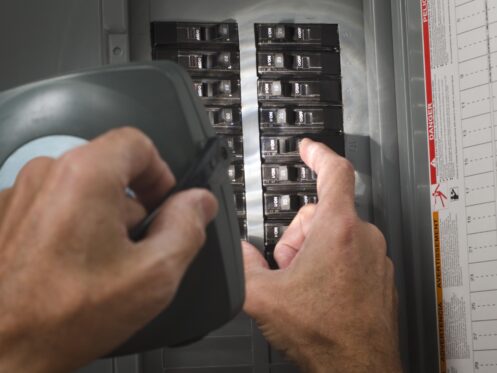
Your home’s electrical panel is one of the most important pieces of your electrical system. From safety to efficiency, every aspect of this system’s performance relies on a functional and safe panel.
Knowing when to upgrade or replace your panel is important, but how do you know when it’s time?
The Panel’s Age
While electrical panels can easily deliver decades of service, a rule of thumb in the industry is to assume a panel needs an upgrade after 25 to 30 years. The main reason is that many common problems can accumulate over time. Connections inside the panel loosen for multiple reasons, including electrical force. Internal components can suffer corrosion due to humidity or flooding, too. As the panel ages, heat will slowly degrade the performance of the materials. Particularly, circuit breakers and their connections to the busbar will degrade.
Also, be aware that a functional electrical panel isn’t necessarily in good shape when you take a closer look. Connections can remain working while developing greater electrical resistance. Electricity can overcome small gaps or degrade materials to some extent. However, overcoming resistance involves consuming extra power. Ultimately, this means greater inefficiency and more money out of your pocket.
Not Enough Capacity
Amperage Capacity and Needs
Especially in older homes, many electrical panels simply don’t provide the amperage capacity that modern life requires. While many older homes have panels that only support 100 amps of total capacity, today’s demands can concurrently eat that up in no time. For example, some HVACs now pull 30 to 50 amps. Add several 15-amp appliances and general household demand for smaller devices, and 100 amps of capacity is gone. If you need to add an EV charger, for example, there just won’t be any remaining overhead.
The current industry-wide recommendation is a 200-amp electrical panel. Some households with large properties or specific higher demands, like garages or home workshops, may need more amperage. Solutions are available, such as split-service 400-amp systems that use two breaker panels and a single distribution panel. Higher capacity panels are also available for large luxury homes and other less common demands.
Considering Circuit Breakers
Adding breakers is an important safety step. Many DIYers make the mistake of adding more demand with wiring or junction boxes. Even putting something like an electric heater in a chilly room can overload a standard 15-amp breaker. This can overload a circuit. The best solution is to relieve the overload by moving some of the demand onto a new circuit.

Taking Into Account Higher Voltages
At-home EV charging stations are driving some people to upgrade their electrical panels. Level 2 chargers are the desirable choice for at-home use because they can typically top off a car’s battery overnight. A Level 2 charger also requires a 240-volt connection to the electrical panel. Many panels offer 240-volt power, but lots of households already populate the 240 slots with circuits for their laundry appliances. Especially if a panel predates the rise of EV chargers, there is a good chance it doesn’t have spare 240-volt capacity.
Achieving Peace of Mind
Many homeowners don’t know much about their place’s electrical panel. Especially if you’re planning to purchase a house, you may want to consider an upgraded panel for peace of mind. You don’t have to worry about the previous installation because you know exactly what’s connected. This gives you a chance to tailor the panel to your needs and future-proof your house. Especially if you pair this with new wiring to match all the circuits’ capacities to the breakers, you can be confident for decades to come.
Optional Safety Features
Grounding, surge protection, and GFCI and AFCI support all work better with the right electrical panel. These are excellent safety improvements for your home’s electrical system, but they’re not always present. A house’s electrical setup could date to before the current version of the National Electrical Code took effect, meaning some of these components might not be present or may have improper specifications.
Signs of Damage
You should ignore an electrical panel that exhibits signs of damage. There might be burn marks, melted plastic, or discolored metal that indicate the system overheated or arced at some point. Bear in mind that panel damage isn’t always visible. The evidence could be a humming or buzzing sound. Likewise, the evidence could be repeated circuit breaker trips or lights dimming when something like the HVAC draws power.
If you’re unsure whether the damage to an electrical panel requires an upgrade, we can inspect it. Sometimes the damage is isolated to one circuit breaker. In that scenario, the solution may be as simple as replacing it.
Fuses and Fuse Boxes
While fuse boxes are largely considered outdated for general residential use, there are still some on the market. Unless you have a specific need, such as a fuse box for a marine environment like a dock, we don’t recommend keeping a fuse box. Even newer models aren’t ideal.
Also, if you have a specific reason for keeping a fuse box, you can connect it as a subcircuit that extends from an electrical panel. This gives you the best of both worlds, providing the quick-reacting benefits of fuses with the more general benefits of an upstream circuit breaker.
Various Smart Technologies
Smart panels and smart circuit breakers are increasingly popular, and not just for trendy reasons. Smart electrical technologies provide usage monitoring tools. With a properly planned electrical system, you can quickly develop a better picture of household demand.
Many people also like the remote capabilities of smart panels and breakers. Especially if you have a circuit that’s a long distance from the other end of your property, smart access is very convenient. You can open the app on your phone and switch the circuit off. This is a great way to reduce needless energy losses from plugged-in devices in workshops, studios, home offices, and other spaces. Particularly if you don’t use the electricity in an area a lot, it may be better to turn off the circuit. When you do need the circuit, just use the app to enable it.
Christian Brothers Air Conditioning Plumbing Electrical is the go-to company for many people who want their work done by a licensed electrical contractor. Our electrical services are trusted by residents of Glendale, AZ, and the surrounding areas. Our business has been here since 1976, and we have an A+ rating with the Better Business Bureau. We perform many kinds of electrical jobs, including installations, repairs, and maintenance.
If your Glendale property is ready for an electrical panel upgrade, contact Christian Brothers Air Conditioning Plumbing Electrical today to discuss your options.